Builder-Grade Roof Problems in New Leander Homes
The most common new construction roof problems are nails driven high or crooked, ridge vents set off-center, missing kick-out flashing, caulk used where metal flashing belongs and missing drip edge. Most of them can’t be seen from the driveway. They’re easiest to get fixed while your builder warranty is still active, so check early and put everything in writing.
Leander has added homes fast. The city went from 60,868 people in the 2020 Census to about 80,000 by 2023, and many of those families moved into new houses in master-planned communities like Bryson, Travisso, Mason Hills and Crystal Falls. A lot of roofs went on in a short time across Williamson County and ZIP 78641.
Fast building doesn’t mean bad work. It does raise the odds that a small miss gets covered by the next course of shingles and stays hidden until wind or rain finds it. This guide covers what to look for, why it matters in Central Texas weather and how to get it fixed.
Why New Construction Roof Problems Happen
New construction roof problems usually come from speed and sequencing, not bad materials. Roofing crews on production builds often work to a tight schedule set by the builder. Other trades follow right behind, and the roof is rarely looked at closely again.
City inspections check code items at set stages. They are not a nail-by-nail review of every shingle. That gap is where most builder grade roof defects live.
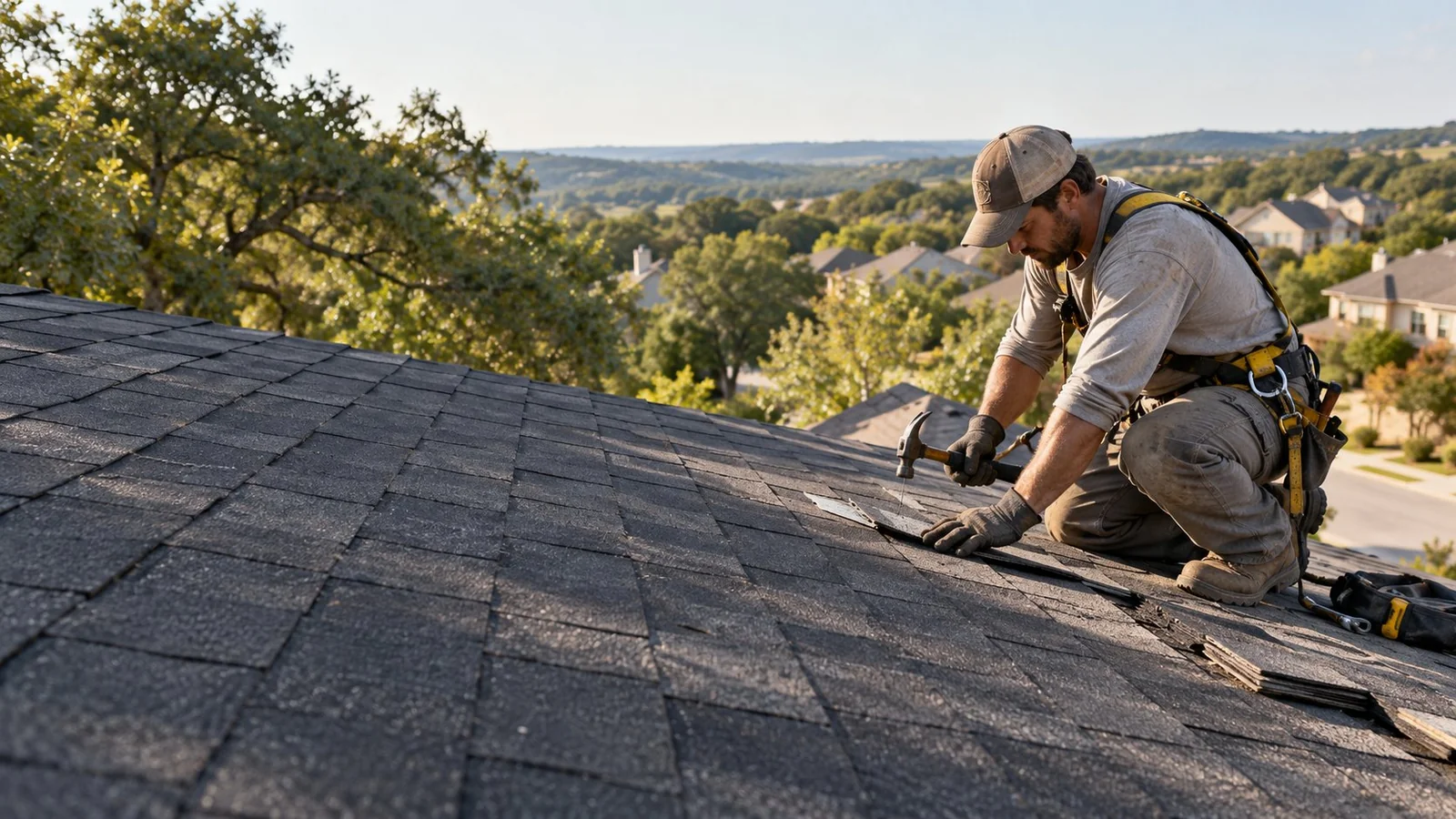
Central Texas weather then puts those mistakes to the test. The Leander area averages about 93 days a year above 90°F, which bakes caulk and attic spaces. Hail season runs mainly from March through June, with a smaller run in September and October, and wind gusts ahead of those storms find any loose shingle.
Homeowners post photos of these defects on Reddit’s r/Austin and r/Roofing, often after a home inspection or the first strong storm. The same short list of new construction roof problems comes up again and again.
The 7 Most Common New Construction Roof Problems
These are the new construction roof problems we see discussed most on newer Leander homes. Each one is worth checking before your warranty dates pass, because new construction roof problems are simplest to resolve while the builder still owns them.
1. Improperly placed fasteners
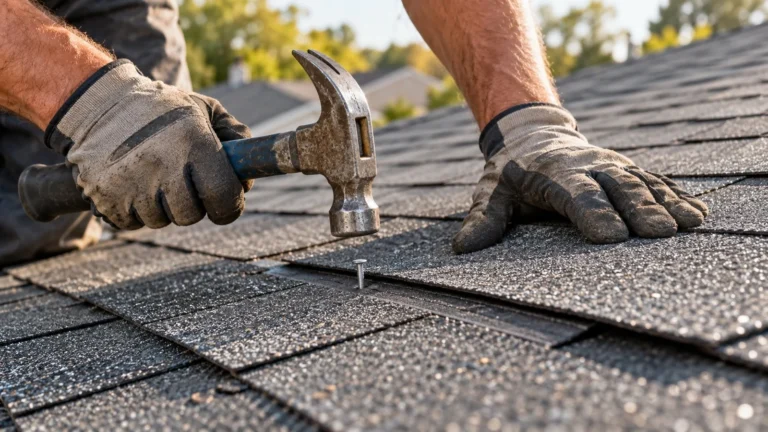
Improperly placed fasteners top the list. Every shingle has a printed nailing zone, and nails need to land inside it, straight and flush. GAF’s installer guidance tells crews to “look out for underdriven, overdriven, or angled nails” and calls four nails per shingle the widely accepted industry standard, noting warranties or codes may require more.
Here’s what each mistake does:
- High nails miss the shingle layer below, so the shingle can slide or blow off in wind.
- Crooked nails leave one edge of the head raised, which can cut into the shingle above.
- Overdriven nails punch into the mat and lose holding power.
- Underdriven nails sit proud and can wear through the shingle above.
2. Ridge vent set off-center
A ridge vent sits over a slot cut along the peak. If the vent is shifted to one side, or the slot is too narrow or uncut in spots, the attic can’t exhaust hot air the way it should. From the street it looks fine.
3. Missing kick-out flashing
Kick-out flashing is a small bent piece of metal at the bottom of a roof-to-wall joint. It throws water into the gutter instead of down the wall. Without it, water runs behind stone, brick or siding and can rot framing for years before anyone sees a stain.
4. Caulk instead of metal flashing
Some crews seal walls, pipes and other joints with a bead of caulk instead of step flashing and counter-flashing. Caulk looks clean on move-in day. Texas sun breaks it down, and once it cracks, water goes straight in.
5. Missing drip edge or no overhang
Drip edge is the metal strip along the eaves and rakes. It guides water into the gutter and keeps it off the fascia. When it’s missing, or the shingles don’t overhang it properly, water wicks back and rots the wood edge.
6. Shingles damaged during delivery or install
Shingle bundles are heavy. When they’re tossed onto the roof, shingles inside can crack or lose their seal strip. A damaged shingle may still get nailed down and show up later as a lifted tab or slow leak.
7. Attic ventilation shortcuts
A roof needs a balance of intake air at the eaves and exhaust at the peak. Soffit vents blocked by insulation, too few intake vents or mismatched exhaust types all trap heat. A hot attic ages shingles faster.
New Build Roof Problems You Can Check Yourself
You can spot some new build roof problems without climbing on the roof. Use binoculars from the yard, a flashlight in the attic and your phone camera. Leave the roof surface to a pro, since steep two-story roofs are a real fall risk.
| What to check | Where | What good looks like |
|---|---|---|
| Shingle rows | From the yard with binoculars | Flat, straight lines, no lifted or creased tabs |
| Roof-to-wall joints | Each side of the house | Metal flashing visible, not just a caulk bead |
| Bottom of each roof-to-wall joint | Where roof edges meet a wall | A bent kick-out directing water into the gutter |
| Ridge vent | From both ends of the house | Straight and centered on the peak |
| Eaves and rakes | Along the roof edges | Metal drip edge with shingles overhanging it |
| Attic ridge | Inside with a flashlight | Daylight through the slot under the ridge vent |
| Attic decking | After a heavy rain | No damp spots or stains |
| Soffits | Attic edges | Insulation not packed against intake vents |
If anything looks off, take a dated photo and write down where it is. A written log of new build roof problems is what gets them fixed. For a deeper walkthrough, see our new roof inspection checklist.
Builder Grade Roof vs a Problem Roof
A builder grade roof is not automatically a bad roof. Builder grade usually means a standard architectural shingle, standard underlayment and standard vents. Installed correctly, that can be a sound roof for many years.
The new construction roof problems in this guide are installation mistakes, not material choices. A premium shingle nailed high will still blow off, and the same new construction roof problems show up on any product line. A basic shingle nailed right, with metal flashing and a centered ridge vent, will usually do its job.
How to Get the Builder to Fix New Construction Roof Problems
The best way to get new construction roof problems fixed is a clear, written, photo-backed list sent before your warranty dates pass. Here’s the process.
- Find your warranty dates. Pull your closing papers and builder warranty. Note each coverage period and how the builder wants requests submitted, often through an online portal or a specific email address.
- Document with dated photos. Number each problem and note its location, like “no kick-out at garage wall, front left.” Photos from a roofer’s inspection are more specific than phone shots from the yard.
- Send one written list. Put every item in one email or letter. Ask for a written reply and a repair date.
- Check the repair. When the builder’s roofer comes back, ask for photos of hidden work like flashing. Don’t sign off until each item is done.
- Know the Texas notice rules. If the builder won’t act, Texas Property Code Chapter 27 sets a formal process for construction defect claims.
Under Property Code Section 27.004, a homeowner must give written notice by certified mail, return receipt requested, at least 60 days before filing suit. The notice must describe the defects in reasonable detail. The builder can ask to inspect within 35 days and may make a written offer within 60 days of receiving the notice.
This is general information, not legal advice. Talk to a Texas attorney before sending a formal notice.
When to Get a New Construction Roof Inspection
The best time is a few months before your workmanship coverage ends. That leaves time to send the list, get a reply and get repairs scheduled. If you just closed, an early look gives you a baseline.
An independent new construction roof inspection gives you dated photos and a written list from someone who doesn’t work for the builder. That makes your request specific and harder to brush off. Our roof inspection in Leander page explains what a full inspection covers.
Check again after the first big storm. Wind and heavy rain often reveal new construction roof problems that looked fine on move-in day. If the builder’s roofer won’t come back, our guide on how to choose a roofer helps you vet someone else.
What If the Warranty Has Already Ended?
New construction roof problems don’t disappear when the warranty does. Most fixes are still small jobs: adding a kick-out, replacing caulked joints with metal flashing, or re-nailing a section. Fixing them early beats repairing rotted wood later.
Keep storm damage and new construction roof problems separate. Homeowners insurance covers sudden events like hail and wind, not workmanship.
Dated photos help show which problem caused what. If hail did hit, see hail damage roof repair. See roof flashing repair for how flashing should be done.
New Construction Roof Problems
What are the most common new construction roof problems?
The most common are improperly placed fasteners, off-center ridge vents, missing kick-out flashing, caulk used instead of metal flashing and missing drip edge. These are installation issues, not material defects. Most can be fixed without replacing the roof.
Are new construction roof problems covered by homeowners insurance?
Usually not. Homeowners insurance covers sudden events like hail or wind, not installation mistakes. Workmanship problems fall under your builder warranty, so check its dates and how to file a request.
Can I hire my own roofer to inspect a new build?
Yes. An independent roofer can inspect the roof and attic and give you dated photos and a written list. Ask your builder in writing about access rules if the home hasn’t closed yet.
How do I know if my nails are placed wrong?
You usually can’t see nail placement from the ground, because the next course of shingles covers it. Signs include shingles that slide, lift or blow off in moderate wind. A roofer can lift a few tabs carefully to check.
What if my builder ignores my list?
Follow up in writing and keep copies of everything. Texas Property Code Chapter 27 requires written notice by certified mail at least 60 days before a construction defect lawsuit. A Texas attorney can tell you how it applies to your situation.
Talk to a Leander Roofer
If you live in a newer home in Leander, Cedar Park or Liberty Hill and want a second set of eyes before your warranty dates pass, call Leander Roof Repair at (512) 254-8474. We inspect the roof and attic, take dated photos of every problem and give you a written list you can send to your builder.