Attic Ventilation in Texas: Why It Matters for Your Roof
Attic ventilation Texas homes depend on is simple in principle: outside air comes in low at the soffits and leaves high at the ridge. That airflow carries heat and moisture out of the attic, so the shingles aren’t baked from below. Get it wrong and a roof can age years early, even when nothing looks wrong from the street.
Leander averages about 93 days a year above 90°F, so heat does most of the damage to roofs here. This attic ventilation Texas guide covers what the building code requires, how intake and exhaust should balance, where radiant barriers fit, and the signs your attic is running too hot.
Attic Ventilation Texas Basics: Heat, Moisture and Shingle Life
Asphalt shingles age through heat and sunlight. The asphalt dries out, the shingles turn brittle and the granules loosen. The sun works on the top of the shingle, and a hot attic works on the bottom.
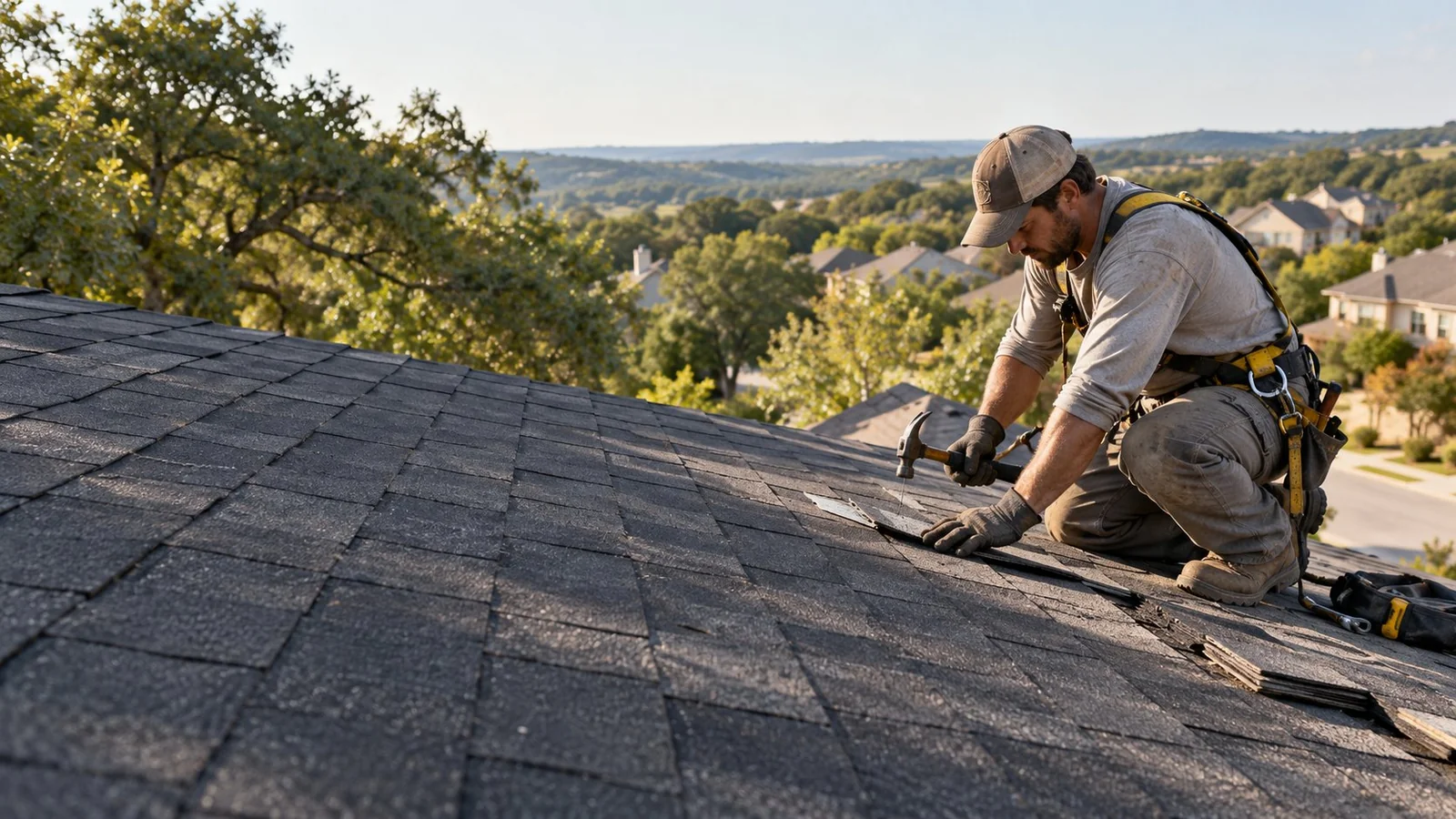
Architectural asphalt shingles often last about 15 to 25 years in Central Texas, depending on hail, ventilation and installation. Ventilation is one of the few items on that list you can actually change. Our post on roof lifespan in Texas covers the rest.
Moisture is the other half of the job. Humid air from showers, cooking and muggy nights can condense on the underside of the decking, leading to stains, rusty nail tips and mildew.
Attic Ventilation Texas Code Rules (IRC R806)
The attic ventilation Texas cities enforce comes from the model code they adopt. Leander uses the 2021 International Residential Code with local amendments. Attic ventilation rules are in Section R806 of the IRC, published by the International Code Council.
The base rule in R806.2: the net ventilating area must be at least 1/150 of the area of the vented space. An exception lets that drop to 1/300 when 40% to 50% of the required vent area sits in the upper part of the attic, no more than 3 feet below the ridge measured vertically, with the rest provided by eave or cornice vents. The exception also has a vapor retarder condition, but that one applies only in Climate Zones 6, 7 and 8, the coldest parts of the country.
For attic ventilation Texas code officials review, here’s what those ratios work out to:
| Attic floor area | At 1/150 | At 1/300 (40% to 50% high, rest low) |
|---|---|---|
| 1,200 sq ft | 8 sq ft of vent area | 4 sq ft of vent area |
| 1,800 sq ft | 12 sq ft of vent area | 6 sq ft of vent area |
| 2,400 sq ft | 16 sq ft of vent area | 8 sq ft of vent area |
Two details trip people up. “Net” area means the open space air can actually pass through, not the size of the vent cover, and manufacturers list it for each product. The code also sets a minimum, so an attic that just meets it isn’t automatically well vented.
Intake and Exhaust: How Attic Ventilation Works
Good attic ventilation is a loop. Cooler air enters low at the eaves, warms up, rises and leaves at or near the ridge. If either end is blocked or undersized, the whole loop slows down.
Soffit vents (intake)
Intake usually means continuous or individual soffit vents under the eaves. The common problem isn’t missing soffit vents but blocked ones. Blown-in insulation can get pushed into the eaves and covers the openings from inside.
Baffles, sometimes called rafter vents, hold insulation back and keep a channel open from the soffit into the attic. If you look into your attic on a bright day and see no daylight at the eaves, the intake may be buried.
Ridge vent (exhaust)
Exhaust is most often a ridge vent: a slot cut along the peak, covered with a vented cap. Other exhaust types include box vents (often called turtle vents), turbines, gable vents and powered fans.
A ridge vent only works if the slot under it was cut and the cap sits centered over it. Ridge vents set off-center are one of the builder-grade defects we see on newer Leander homes.
Keep intake equal to or greater than exhaust
GAF’s technical bulletin on attic ventilation says a balanced system moves 50% of the airflow through the soffit, and that ridge exhaust should not exceed soffit intake. When exhaust outweighs intake, the attic pulls air from wherever it can, including the living space below.
Mixing Vent Types: A Common Attic Ventilation Texas Mistake
Mixing exhaust types on one attic, such as a ridge vent plus box vents or a power fan, can short-circuit the airflow. One exhaust pulls air in through the other instead of drawing it from the soffits. GAF warns that mixed systems, like soffit and ridge vents combined with a power fan, can reverse airflow and let water into the attic.
GAF’s guidance for continuous soffit and ridge venting, in short:
- Remove or disconnect power fans, roof louvers, static exhaust vents and other roof vents.
- Close gable vents.
- Use one exhaust system per attic space.
This tends to happen on homes where vents were added over time. A ridge vent goes on during a re-roof but the old box vents stay, or a solar fan gets added to a roof that already has a ridge vent. A re-roof is the easiest time to sort it out; see our roof replacement page for what a full job includes.
Radiant Barriers and Solar Attic Fans
Radiant barrier
Radiant barriers come up in almost every attic ventilation Texas conversation. A radiant barrier is a reflective layer, usually on the underside of the roof deck, either built into the decking or stapled to the rafters.
The U.S. Department of Energy says some studies show radiant barriers can reduce cooling costs 5% to 10% in a warm, sunny climate.
A radiant barrier and attic ventilation do different jobs. The barrier cuts radiant heat coming off the hot deck, and ventilation moves warm air out. DOE also notes the reflective side must face an air space, and dust on it reduces how well it reflects.
Solar attic fans
Solar attic fans are an add-on attic ventilation Texas homeowners often ask about, especially for hip roofs with short ridges. A fan only pulls as well as the intake feeds it. With blocked soffits, it can draw conditioned air out of the house through ceiling gaps and light fixtures.
Paired with a ridge vent, a fan can also pull air in through the ridge instead of the soffits. If you already have a ridge vent and clear soffit vents, a fan is usually not the fix.
7 Signs of Poor Attic Ventilation Texas Homeowners Can Spot
These signs show up in the attic, on the roof and in your comfort upstairs:
- The attic stays much hotter than outdoors well after sunset.
- The underside of the decking is darkened, stained or mildewed.
- Nail tips poking through the deck are rusty or have drip marks below them.
- Insulation is matted, damp or packed tight against the eaves.
- Hot attic shingles show blistering, curling or heavy granule loss earlier than expected.
- Upstairs rooms stay hot and the AC runs long on summer afternoons.
- No daylight shows at the eaves from inside the attic.
Some of these have other causes, such as duct leaks or a shingle defect. A full roof inspection in Leander should cover the attic as well as the roof surface.
Ventilation and Your Shingle Warranty
Poor ventilation can limit what a shingle warranty covers. GAF’s bulletin says damage caused by inadequate ventilation is not covered by its warranty, while manufacturing-defect coverage still applies. Other manufacturers have their own language, so read the warranty for your specific shingle.
Treat the code minimum for attic ventilation Texas cities enforce as a floor, not a target.
That matters for attic ventilation Texas homeowners overlook until a claim. Heat damage from a cooking attic can look like early shingle failure. If poor ventilation is the cause, the manufacturer may decline.
Where Leander Homes Fall Short
The attic ventilation Texas homes need is the same in every neighborhood, but problems show up in Leander homes of every age, from Old Town Leander to Crystal Falls to Bryson, and they look different:
- Older homes may rely on a few box vents and small soffit vents that fall short of today’s ratios.
- Production homes in newer subdivisions off Ronald Reagan Blvd and San Gabriel Pkwy can have off-center ridge vents or insulation blown over the soffits.
- Homes with additions or past re-roofs are the most likely to have mixed exhaust types.
- Homes under big live oaks, common in Crystal Falls, can have soffit vents clogged with leaves and debris.
Overflowing gutters can soak soffits and clog intake too; see our gutter installation page. For newer homes, our post on new construction roof problems covers other builder-grade defects.
How We Check Attic Ventilation
Every attic ventilation Texas check we do starts in the attic, not on the roof:
- Call and tell us about the roof, vents or anything in the attic that worries you.
- We inspect the roof and attic, measure the attic floor area, count intake and exhaust, and take dated photos of every problem.
- You get a written estimate before any work.
- Fixes use vents sized to the attic, metal flashing instead of caulk, and fasteners to the manufacturer’s spec.
- We clean up with a magnet sweep and pull permits when the City of Leander requires them.
Common fixes include clearing or adding soffit vents, installing baffles, cutting a proper ridge slot, and removing extra exhaust vents and flashing the old holes.
Attic Ventilation Texas Questions
What attic ventilation Texas code ratio applies in Leander?
The 2021 IRC, which Leander uses, sets the minimum net ventilating area at 1/150 of the attic floor area. It drops to 1/300 when 40% to 50% of the vent area is within 3 feet of the ridge and the rest is low at the eaves. For an 1,800 sq ft attic, that’s 12 or 6 sq ft.
Is a ridge vent better than box vents?
A continuous ridge vent with continuous soffit intake usually moves air more evenly along the whole roof. Box vents can work if they’re sized and placed right. The bigger issue is not mixing the two on one attic.
Do solar attic fans help in Texas?
They can on roofs that can’t fit enough ridge vent. They can also pull conditioned air from the house or pull air in through a ridge vent. A fan only works as well as the soffit intake feeding it.
Is a radiant barrier enough on its own?
No. A radiant barrier cuts radiant heat from the deck but doesn’t move air. You still need balanced intake and exhaust to carry heat and moisture out of the attic.
Can poor attic ventilation cause roof leaks?
Indirectly, yes. Condensation can drip from rusty nail tips and stain ceilings, which looks like a leak. GAF also warns that mixed vent systems can let water into the attic.
Talk to a Leander Roofer
If your attic runs hot or your shingles are aging fast, call Leander Roof Repair at (512) 254-8474. We’ll check your attic against the attic ventilation Texas code minimums Leander enforces and give you dated photos and a written estimate.