Signs of Hail Damage on Your Roof (and What to Check From the Ground)
The signs of hail damage on roof shingles are dark bruises where granules were knocked off, round dents in soft metal, and cracks or broken corners on the shingle edges. From the ground, the best clues are fresh dents in gutters, downspouts and AC fins, plus piles of granules at downspout outlets after a Leander storm.
You don’t need to climb a ladder to learn most of what you need. This guide gives you a ground-level checklist, explains what a roofer looks for up top, and shows what is not hail damage, so you can decide whether to call.
Why Leander Roofs Need a Close Look After Hail
Hail is routine in this corner of Williamson County. StormerSite has logged 105 hail reports within 10 miles of Leander (ZIP 78641) since 2004, and 73 came in April or May. On May 16, 2025, hail up to 3 inches fell in north and central Leander, with 2.75 inches measured in Deerbrooke and 2 inches in Carneros Ranch.
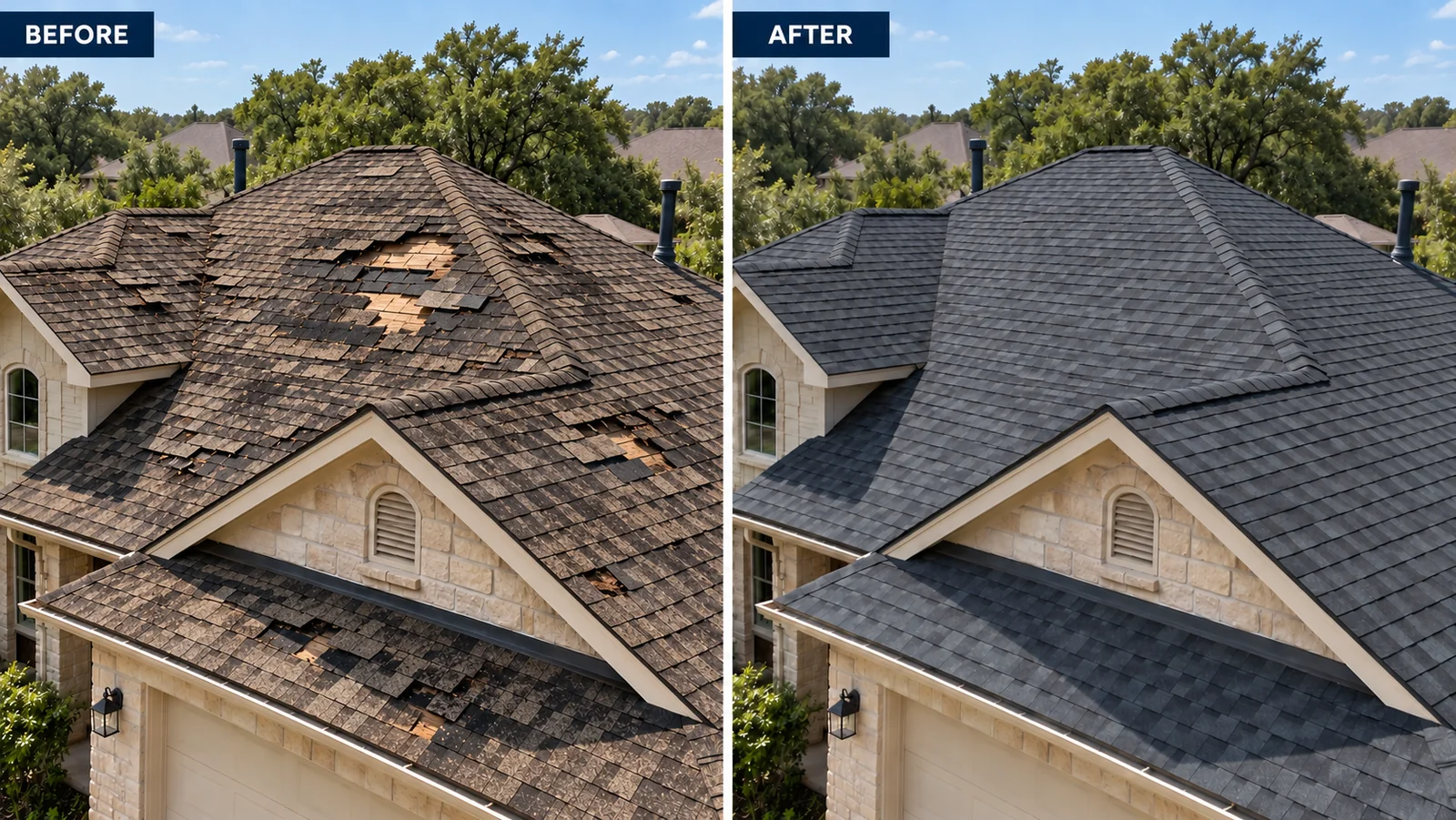
The National Weather Service calls hail 1 inch across, about quarter size, severe. Hail that size and larger is when signs of hail damage on roof surfaces become likely, especially on shingles that have baked through a few Leander summers. For dates and sizes near you, see our Leander hail history.
How to Tell If Your Roof Has Hail Damage From the Ground
Start on the ground, the day after the storm, in good light. Stay off the roof. A wet or damaged roof is dangerous, and walking on it can create the very scuffs that confuse an inspection.
- Gutters and downspouts. Look for round dents along the gutter face and on downspout elbows. Fresh dents are shiny; old ones are dull.
- Downspout outlets. Check splash blocks for piles of dark granules. A sudden heavy dump after one storm points to hail.
- AC condenser. Look at the fins and the top of the unit for dents or flattened fins.
- Roof vents and pipe flashing. With binoculars, look for dings on box vents, turbine vents and metal flashing.
- Window screens and wood trim. Torn screens, chipped paint and dented garage door panels show hail size and direction.
- Fences, mailboxes and patio furniture. Spatter marks and dents tell you where the hail came from.
- Your car. If an uncovered car has dents, your roof took hits too.
- Skylights. Look for cracks or crazing on domes and lenses.
- Ceilings and the attic. Watch for new stains or drips over the next few days.
Check every side of the house. Wind drives hail sideways, so the slopes facing the storm can show signs of hail damage on roof shingles while the back slopes look clean.
Signs of Hail Damage on Roof Shingles
These are the signs of hail damage on roof shingles a roofer looks for on top. Some are hard to see from the ground, which is why an inspection matters.
| Sign | What it looks like | Why it matters |
|---|---|---|
| Bruising | Dark spot where granules were knocked off; soft when pressed | Exposes asphalt to sun; shortens shingle life |
| Granule loss in circles | Random round bare spots, not a uniform wear pattern | Classic hail mark on asphalt |
| Cracks and fractures | Split shingle, often with a crescent shape | Lets water reach the underlayment |
| Broken corners and edges | Torn tabs, chipped ridge caps | Water and wind can get under the shingle |
| Exposed mat | Fiberglass mat showing through | Leaks follow quickly |
| Seal strip damage | Shingle tab no longer stuck down | Wind can lift it in the next storm |
Damage on asphalt shingles is random. Real hail leaves hits scattered across a slope with no pattern. Many adjusters count hits inside a 10-by-10-foot test square and look for a certain number, often around 8 to 10, though the threshold varies by insurer.
Signs of hail damage on roof ridge caps
Ridge caps take the hardest hits because they sit on top and are bent over the peak. Cracked or crushed ridge caps are one of the first signs of hail damage on roof lines in Bryson, Travisso and other newer neighborhoods. They are also among the easiest to spot from the street with binoculars.
Signs of Hail Damage on Roof Metal and Vents
Soft metal records every hit, so dents are the clearest signs of hail damage on roof parts and the best proof of hail size.
- Box vents and turbines: Round dents across the top
- Pipe boot flashing: Dents in the metal base, and splits in old rubber collars
- Drip edge and valley metal: Dents along edges
- Gutters: Dents along the front lip and top edge
- Metal roofs: Dents in panels, and sometimes split seams or loosened fasteners
A dented gutter or vent is useful evidence even when the shingles look fine. On a metal roof, a dent that still sheds water may be treated as cosmetic by some policies. Check your declarations page or ask your agent, and ask your roofer to separate cosmetic dents from functional damage.
Signs of Hail Damage on Roof Decking and in the Attic
Most hail damage stays on the surface at first. Over time, cracked shingles let water reach the underlayment and decking. In the attic, look for:
- Water stains on the underside of the decking
- Damp insulation below a cracked area
- Daylight through nail holes or broken shingles
- A musty smell after a rain
If you find any of these, water is getting in. These are late signs of hail damage on roof systems, so get the area covered before the next storm.
What Is NOT Hail Damage
Some roof problems look like hail but aren’t. Knowing the real signs of hail damage on roof shingles saves a wasted claim and an argument with an adjuster.
| Looks like hail | What it usually is | How to tell |
|---|---|---|
| Small round pits | Blistering from heat or poor attic ventilation | Pits are open and spread evenly, not random hits |
| Scuffs and crushed granules | Foot traffic from installers, inspectors or cable techs | Found along walking paths, near vents and dishes |
| Even granule loss everywhere | Normal aging in Texas sun | No dents in nearby metal; worse on south slopes |
| Straight cracks across shingles | Thermal cracking or a manufacturing issue | Cracks follow a pattern, not impact points |
| Raised bumps in rows | Nail pops from high or crooked fasteners | Lined up along nail courses |
| Lifted tabs | Wind or poor sealing | No bruising or dents nearby |
Builder-grade defects are common on newer Leander homes. Nails driven high or crooked, missing kick-out flashing and caulk instead of metal flashing all cause problems that are not hail. A good inspection separates hail from those issues.
Signs of Roof Damage Requiring Repair Right Away
Some signs mean you shouldn’t wait for the insurance process to play out:
- Water dripping into the house or attic
- Missing shingles or exposed decking
- A cracked or shattered skylight
- A large limb resting on the roof
- Sagging decking or soft spots
For any of these, get the area tarped with a written estimate first. See emergency roof repair for what that involves.
Photos to Take After a Leander Hail Storm
Good photos make every next step easier, whether you file a claim or not.
- Hailstones next to a coin or ruler, as soon as possible
- Every dented gutter, vent and AC fin, with a wide shot showing which side of the house
- Granule piles at downspouts
- Ceiling stains, with a date on the photo
- The whole house from each side
Keep the photos in one folder with the storm date. If you’re unsure whether to file, read our Texas roof insurance claims guide first. Your policy and deductible decide whether a claim makes sense, so check your declarations page or ask your agent.
When to Call a Roofer
Call for an inspection if you see dents in gutters or vents, granule piles, or any of the signs of hail damage on roof shingles listed above. Call too if hail of quarter size or larger hit your street, even if you see nothing. Bruised shingles in Crystal Falls or Mason Hills can look fine from the ground and still crack later.
We don’t door-knock after storms. We take dated photos of every problem, give a written estimate before any work, and can meet your adjuster on site if you ask. Learn more on our hail damage roof repair page or book a roof inspection in Leander.
Signs of Hail Damage on Roof Questions
What are the first signs of hail damage on roof shingles?
The first signs are dark bruises where granules were knocked off, cracked ridge caps and dents in metal vents. From the ground, fresh dents in gutters and granule piles at downspouts are the easiest clues. A roofer confirms the shingle damage up close with dated photos.
How do I tell if my roof has hail damage without climbing on it?
Check gutters, downspouts, AC fins, window screens and your car for fresh dents. Look for granule piles at downspout outlets and use binoculars on vents and ridge caps. If you see any of these, have the roof inspected.
Can hail damage a roof without causing a leak?
Yes. Bruised shingles often don’t leak at first, but lost granules leave the asphalt exposed to sun and the mat can crack later. That’s why an inspection after hail of quarter size or larger is worth it even when the ceiling looks fine.
Is granule loss always a sign of hail damage on roof shingles?
No. Some granule loss is normal aging, especially on shingles that have been through many Texas summers. Hail leaves random round spots of missing granules, often with dents in nearby metal.
How soon should I check my roof after a hailstorm in Leander?
Check from the ground the next day, in good light, and take dated photos. Book an inspection within a few days, before the next storm. Watch ceilings and the attic for new stains over the following week.
Talk to a Leander Roofer
If you’ve spotted signs of hail damage on roof vents, gutters or shingles, call Leander Roof Repair at (512) 254-8474. We’ll inspect, give you dated photos and a written estimate, and tell you plainly what we find. See our Leander roof repair services.