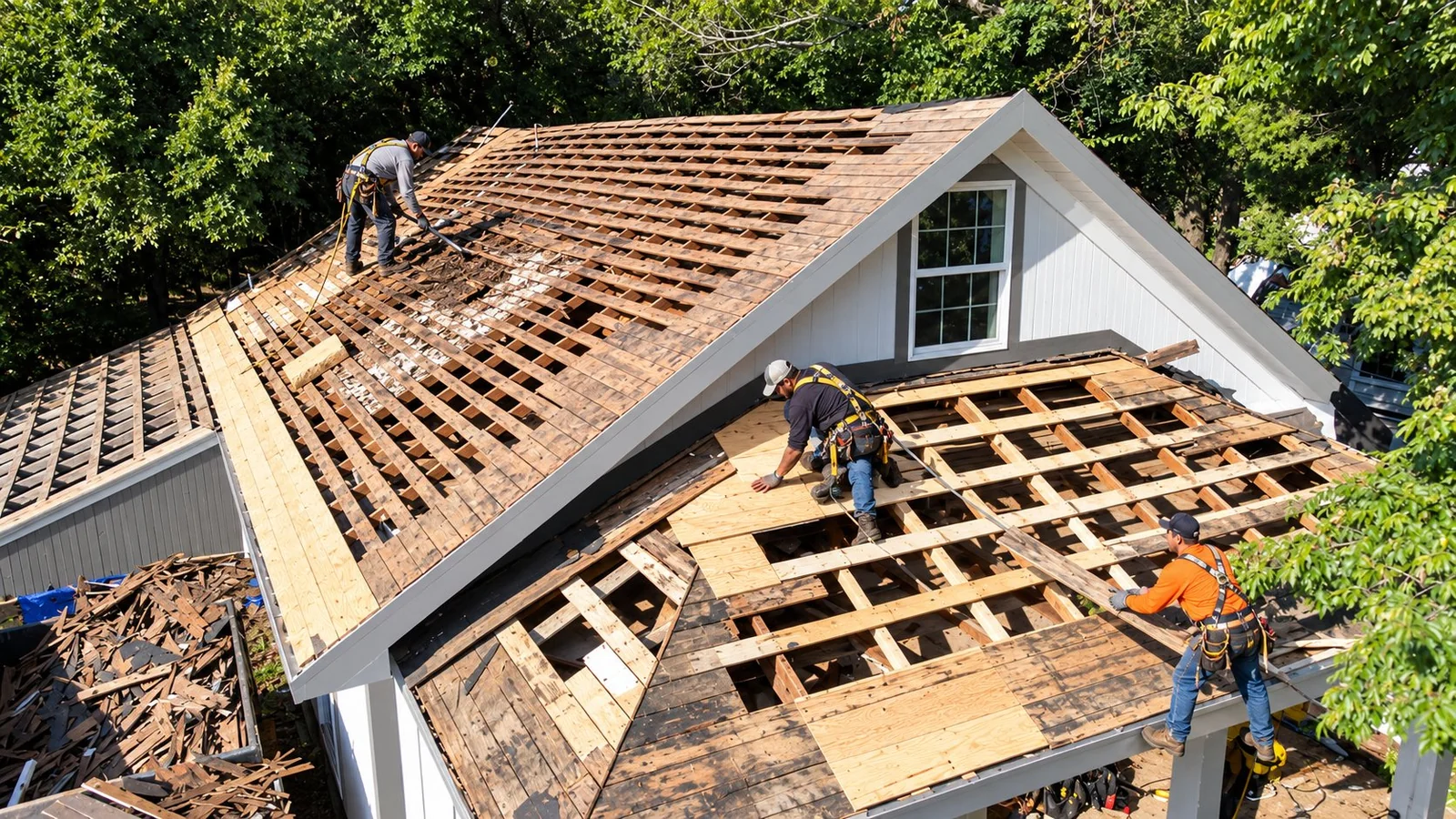
Storm & wind damage · Leander, TX 78641
Storm Damage Roof Repair in Leander, TX
Storm damage roof repair in Leander starts with finding what the wind, a falling limb or ice actually broke: creased shingles, torn ridge caps, bent flashing or cracked decking. Leander Roof Repair inspects the roof and the attic, documents every problem with dated photos, and gives you a written estimate before any work, tarps included.
Updated October 2026 · Leander Roof Repair, Leander, TX
What Does Storm Damage Roof Repair Involve?
Storm damage roof repair means fixing what a storm actually broke, not just what you can see from the yard. That usually means replacing creased or missing shingles, resetting ridge caps and flashing, and replacing cracked decking under a fallen limb. Every job starts with a look at the roof and the attic.
In Leander, most non-hail roof damage comes from three things: straight-line wind, falling limbs and ice. Hail has its own page, hail damage roof repair, because it damages a roof in a different way. This page covers the rest.
How Wind Damages a Leander Roof
The National Weather Service calls a thunderstorm severe when it brings winds of 58 mph or more, or hail 1 inch or larger (NWS). It notes that microbursts push wind straight down and outward, and that snapped and uprooted trees are common with straight-line wind. Spring squall lines crossing Williamson County bring exactly this kind of wind.
Wind rarely peels a whole roof off a home in Crystal Falls or Travisso. What it does is smaller and easier to miss. That’s why good storm damage roof repair, and wind damage roof repair in particular, starts with a close look, not a glance from the driveway.
Creased and lifted shingles
A gust gets under the edge of a shingle and bends it up. The shingle may lie back down, but now it has a crease across it and a broken seal strip.
From the street it looks fine. In the next storm, that shingle tears off or lets wind-driven rain in.
Missing shingles, ridge caps and edge metal
Shingles along the rakes, the eaves and the ridge take the most wind. Ridge caps and drip edge are often the first parts to go. Roofs with nails driven high or crooked, a common builder-grade defect on newer Leander homes, lose shingles more easily because the nail misses the strip it’s meant to hold.
Bent flashing and vents
Wind can bend step flashing, lift a roof vent or tear a pipe boot. Each one is an opening for water. These need new metal flashing and new parts, not a bead of caulk.
Fallen Limbs and Ice Storms
Mature live oaks shade a lot of Leander yards, especially in Crystal Falls. After a windstorm or a hard freeze, they’re one of the most common reasons a roof needs storm damage roof repair.
The February 2023 ice storm brought down tree limbs across the Austin area. Winter Storm Uri in February 2021 left ice and snow sitting on roofs for days.
A limb that hits a roof can crack shingles, punch through decking or break a rafter. Ice can also back water up under shingles at the eaves.
What a limb strike needs
Good storm damage roof repair after a limb strike follows the same order every time.
- Get the limb off safely. A big limb on a roof is a job for a tree crew, not a homeowner with a chainsaw.
- Check the decking. Cracked or punctured plywood has to be cut out and replaced.
- Check the framing. We look at rafters and trusses from the attic for cracks or sag.
- Replace underlayment and shingles. We match the existing shingles as closely as we can.
What Should You Do Right After a Storm?
Stay off the roof, take photos from the ground and inside, and stop any leak from spreading. Then get the roof and attic inspected before you decide anything about insurance. Don’t sign anything on the spot, and don’t let anyone tear off shingles before the damage is documented.
Here is the order we suggest:
- Make sure everyone is safe. Watch for downed power lines and stay well away from them.
- Photograph everything. Take wide shots of each side of the house, close-ups of shingles in the yard and any ceiling stains. Your phone saves the date.
- Catch any water inside. Use buckets and towels, and move valuables. Our roof leak repair page walks through this.
- Write down the date and time of the storm. You’ll need it if you file a claim.
- Call us at (512) 254-8474. Describe what you can see.
- Get the roof and attic inspected. We document every problem with dated photos.
- Decide on insurance after you see the findings. Small damage may cost less than your deductible.
When Does a Storm-Damaged Roof Need a Tarp?
A roof needs a tarp when water is getting in, or when a hole, a missing section or a limb strike leaves the decking open. A tarp keeps rain out until the permanent storm damage roof repair. It is a stopgap, and you should see a written estimate before it goes on.
Most tarps last only about 90 days, and Leander sun breaks them down. Plan the permanent repair soon after. Our emergency roof repair page explains how we tarp and what to expect.
Storm Damage Roof Repair or Full Replacement?
Most wind damage is repairable, and storm damage roof repair is usually the right first step. A handful of creased shingles, a lost ridge cap or one limb strike can be fixed by replacing the damaged area with matched shingles.
Replacement makes more sense in these cases:
- Damage is spread across several slopes.
- The shingles are old and brittle, so repairs break more than they fix.
- Your shingle is discontinued and a patch would look badly mismatched.
- The roof has wind damage on top of earlier hail damage.
Texas has no statewide rule that forces a full replacement once a set share of the roof is damaged. The “25% rule” you may hear about comes from the Florida Building Code.
If replacement is the right call, see roof replacement. The City of Leander lists re-roofing among exterior work that doesn’t need a building permit, but it asks owners to confirm with its Permits & Building Inspections Department before work starts. We check with the City before any re-roof.
Storm Damage Roof Repair at a Glance
| What you see | What it usually means | Typical storm damage roof repair |
|---|---|---|
| Shingles in the yard | Shingles torn off by wind | Replace with matched shingles and check nailing nearby |
| A tab bent up or creased | Broken seal strip | Replace the creased shingles |
| Ridge cap missing or loose | Wind at the peak | Reset or replace the ridge cap |
| Limb on the roof | Possible cracked decking or rafter | Remove limb, replace decking, underlayment and shingles |
| New ceiling stain after a storm | Wind-driven rain under lifted shingles or flashing | Trace the leak and fix the source |
| Bent drip edge or flashing | Wind at edges and walls | Replace with new metal |
| Icicles or stains at the eaves after a freeze | Ice backing water under shingles | Check underlayment and decking at the edge |
Storm Damage Roof Repair and Insurance in Texas
Most homeowners policies cover sudden damage from wind, falling limbs and ice. They don’t cover wear, age or poor installation.
Many Texas policies carry a separate wind and hail deductible of 1% to 3% of the home’s insured value. On a typical Leander home, that’s a real amount of money. It’s why we suggest an inspection before a claim: if the repair costs less than your deductible, filing won’t help you.
Some policies pay actual cash value first and release recoverable depreciation after the work is done. Our guide to Texas roof insurance claims walks through the process step by step.
What Texas law says
Under Texas Insurance Code 4102.163, a roofer can’t act as your adjuster or negotiate your claim. Business and Commerce Code 27.02 bars a roofer from waiving, absorbing or rebating your deductible, and insurers can ask for proof that you paid it. The Texas Department of Insurance explains both rules.
We follow both. We give you dated photos and a written estimate, and we can meet your adjuster on site if you ask. The claim itself is between you and your insurer.
How to Spot Storm Chasers After a Storm
After a big storm, crews from out of town often work neighborhoods like Bryson, Mason Hills and Deerbrooke door to door. The Leander Neighbors Facebook group regularly has posts warning about these solicitors after storms.
Watch for these warning signs:
- A knock on the door offering to “take care of everything” with your insurance.
- An offer to cover or “work with” your deductible. That is illegal in Texas.
- Pressure to sign today, or paperwork that hands your claim to the roofer.
- No local phone number and no clear way to reach them later.
We don’t knock on doors. We work when you call us, and our written estimates come with no same-day deadline.
How We Handle Storm Damage Roof Repair in Leander
- You call of the roof, the yard and any stains.
- We inspect the roof and attic and take dated photos of every problem.
- You get a written estimate, with no pressure and no same-day deadline.
- We make the repair with matched shingles, metal flashing instead of caulk, and nails placed where the shingle maker specifies.
- We clean up, run a magnet sweep for nails, and send before-and-after photos.
We handle storm damage roof repair across ZIP 78641, from Carneros Ranch and North Creek Ranch near San Gabriel Parkway down to Lakeline Ranch. Nearby towns are listed on our service area page.
Storm Damage Roof Repair Questions
How soon after a storm should I get my roof checked?
As soon as it’s safe. Some damage, like a creased shingle, only leaks in the next storm. Early dated photos also help a claim, because they tie the damage to a specific storm date.
Can wind damage a roof without any missing shingles?
Yes. Wind can crease a shingle and break its seal while the shingle still lies flat. You usually can’t see it from the ground, so we lift and check shingles on the windward slopes during the inspection.
Does a fallen limb always mean a new roof?
No. Most limb strikes damage one area of the roof. Storm damage roof repair for a limb usually means replacing the cracked decking, underlayment and shingles in that section and checking the framing from the attic.
Will my insurance pay for storm damage roof repair?
It depends on your policy, your deductible and the cause. Sudden wind, limb and ice damage is usually covered, while wear and age usually aren’t. The claim is between you and your insurer, and we can provide dated photos and a written estimate.
Is it safe to wait until spring to fix storm damage?
It’s risky. A lifted or creased shingle can let water in during the next rain, and hidden leaks soak decking and insulation. If you need time, a tarp can protect the roof, but most last only about 90 days.
Storm Hit Your Roof? Get It Documented First
Call Leander Roof Repair at (512) 254-8474 with photos of the roof and yard. We’ll inspect the roof and attic, document what we find and give you a written estimate before any storm damage roof repair starts.