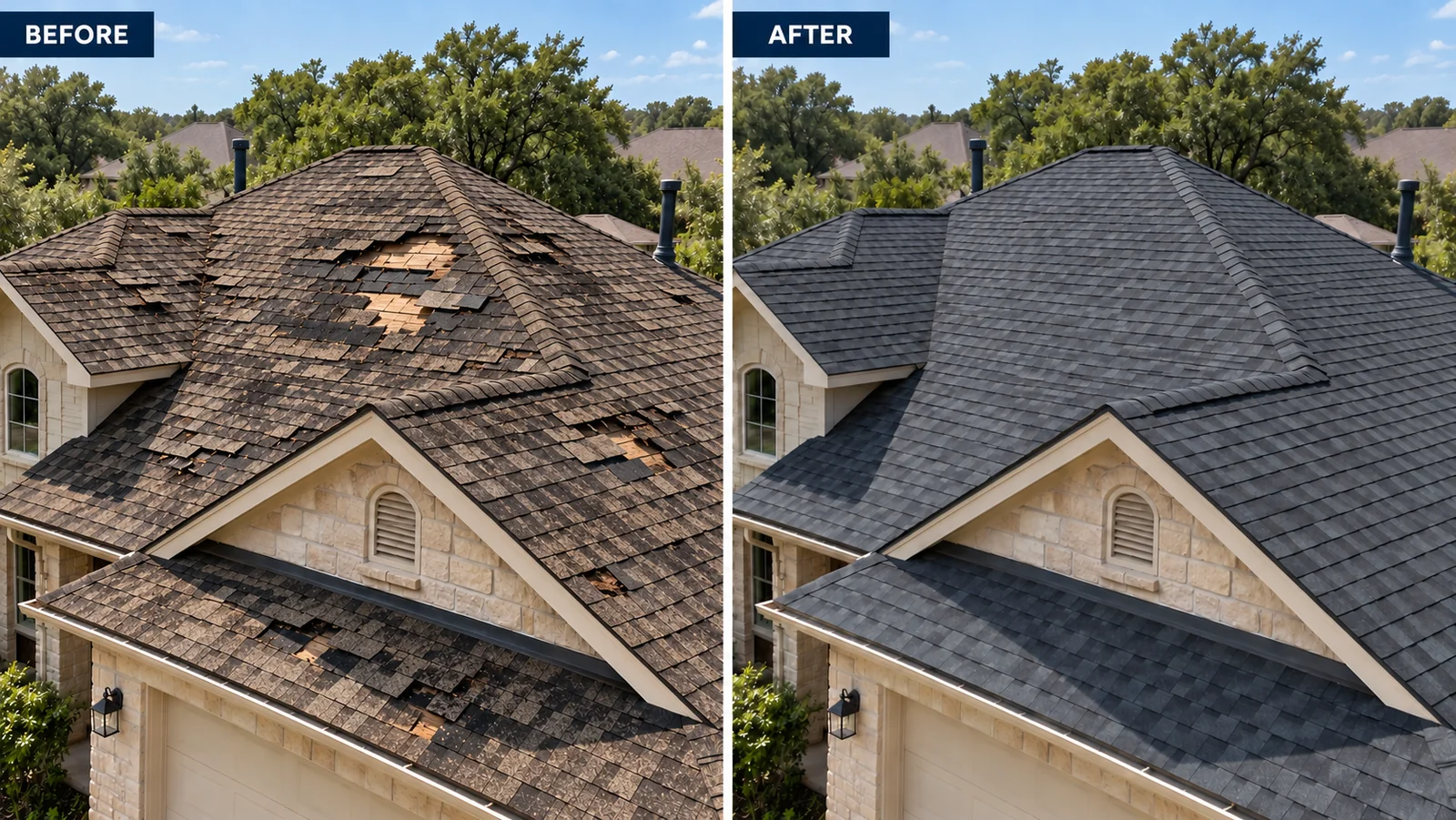
Hail damage roof repair · Leander, TX
Hail Damage Roof Repair in Leander, TX
Hail damage often can’t be seen from the yard. It bruises shingles, knocks off granules and cracks the mat underneath, and leaks can show up months later. Leander Roof Repair checks every slope up close, marks and photographs each hit with the date, and tells you plainly whether the damage needs a repair, a replacement or nothing at all.
Updated October 2026 · Leander Roof Repair, Leander, TX
How Often Hail Hits Leander
Hail is the most common reason Leander roofs get repaired or replaced. Texas has led the country in major hail events for 11 straight years, according to the National Insurance Crime Bureau. Closer to home, StormerSite has logged 105 hail reports within 10 miles of Leander since 2004. 73 of those fell in April or May.
| Date | What fell | Where it was reported |
|---|---|---|
| May 28, 2025 | Golf-ball-size hail | Near Leander and Cedar Park |
| May 16, 2025 | Hail up to 3 inches | 2.75 in in Deerbrooke, 2 in in Carneros Ranch, golf-ball size near North Creek Ranch, 1.5 in near Plain Elementary |
Hail season runs mainly March through June, with a smaller run in September and October. If your neighborhood was in the path of the May 2025 storms and nobody has looked at your roof up close since, it’s worth checking now. Damage that has been sitting for a year or two can be harder to claim and is more likely to leak.
What Hail Does to a Shingle Roof
- Bruising. A hit cracks the fiberglass mat inside the shingle. It feels soft when pressed, and it may look like nothing from the ground.
- Granule loss. Granules protect the asphalt from UV. Where hail knocks them off, the shingle ages fast in Texas sun.
- Cracks and punctures. Large hail can split shingles or punch through them, especially on older, brittle roofs.
- Broken seals. Hail and the wind that comes with it can break the seal strip, so shingles lift in the next storm.
- Damage to metal parts. Dented vents, ridge vents, flashing, gutters and downspouts are often the easiest evidence to spot.
- Cracked skylights and vent caps, which can leak right away.
Signs of Hail Damage You Can Check From the Ground
You don’t need to climb on the roof to find out whether it’s worth a closer look:
- Gutters and downspouts: look for dents and dings.
- Downspout outlets: look for piles of shingle granules, which look like coarse black sand.
- Soft metal: check AC fins, mailboxes, window screens and patio furniture for dents.
- Cars: if your car or your neighbor’s took hits in the same storm, the roof almost certainly did too.
- The roof itself: look for dark spots where granules are missing, or shingle pieces in the yard.
If you see two or more of these, have the roof inspected up close. Bruising is hard to see without touching the shingle.
How We Inspect a Roof for Hail Damage
- We check the ground-level evidence first: gutters, downspouts, AC units and screens.
- We walk every slope. Hail usually hits the slopes facing the storm hardest, so all four sides get checked, not just one.
- We mark and count hits in test areas. Many adjusters look for a certain number of hits, often around 8 to 10, inside a 10-by-10-foot test square. The threshold varies by insurer.
- We photograph every hit with the date, along with dented metal, cracked skylights and damaged vents.
- We check the attic for daylight, wet decking or cracked boards.
- We tell you straight whether the damage needs a repair, a replacement or no work at all.
Repair, Replace or Leave It Alone?
| Situation | What usually makes sense |
|---|---|
| A few hits on one slope, roof under about 15 years old | Repair the damaged shingles and metal parts |
| Hits across several slopes, granule loss and cracked shingles | Replacement, and a possible insurance claim |
| Dented gutters and vents only, shingles sound | Replace the damaged metal parts, or nothing at all |
| Cosmetic dents on a metal roof, no leaks | Often no repair needed; check your policy’s cosmetic-damage terms |
Shingles that were installed 10 or more years ago can be hard to match. If a matching product isn’t available, we’ll show you the closest match before any work starts.
Hail Damage and Your Insurance
When to file a claim
Many Texas policies now carry a separate wind and hail deductible of 1% to 3% of the home’s insured value. On a $450,000 home, a 2% deductible is $9,000. If the repair costs less than that, a claim pays nothing and still goes on your record. If damage is spread across the roof, a claim is often worth filing.
What to know about the policy
- Cosmetic damage exclusions. Some newer Texas policies don’t pay for hail dents that don’t affect how the roof works, especially on metal roofs.
- Actual cash value vs replacement cost. Some policies pay only the depreciated value of an older roof.
- Deadlines. Policies set time limits for reporting damage, so don’t wait a year to have the roof checked.
What Texas law requires
The claim is yours. Texas Insurance Code 4102.163 bars a contractor working on your home from adjusting or negotiating your claim. Business and Commerce Code 27.02 bars a contractor from waiving, absorbing or rebating your deductible, and your insurer can ask for proof you paid it. If anyone offers to “take care of your deductible,” walk away. The Texas Department of Insurance explains both rules.
We give you dated photos and a written estimate, and we’ll meet your adjuster on site if you ask us to.
Should You Upgrade to Class 4 Shingles?
Impact-resistant shingles rated Class 4 under UL 2218 are tested to take a 2-inch steel ball without cracking. Many Texas insurers offer a premium discount for Class 4 roofs. According to the Texas Department of Insurance, each insurer sets its own discount and paperwork, and the installer must complete TDI form PC068 after installation. Ask your agent what discount applies before you choose shingles. Leander’s hail record makes this worth asking about on any roof replacement.
Hail Damage Roof Repair FAQs
What size hail damages a roof?
Hail about 1 inch across (quarter size) and larger can damage asphalt shingles, especially older ones. Smaller hail can still dent soft metal like vents and gutters. Wind-driven hail does more damage than hail falling straight down.
Can hail damage cause a leak later?
Yes. A bruised shingle may keep water out at first, but the cracked mat and missing granules let it break down faster. Leaks often show up months or a year after the storm.
How long do I have to file a hail claim in Texas?
It depends on your policy. Many policies set a deadline for reporting damage, often measured from the date of the storm. Check your policy or ask your agent, and have the roof checked soon after any hailstorm.
Does a hail claim raise my premium?
It can. Claims for weather events are treated differently from claims you cause, but insurers can still factor them into renewals. That’s another reason not to file for damage that costs less than your deductible.
Do I need a roofer at the adjuster’s inspection?
You don’t have to have one. Some homeowners like having the roofer there to point out the damage they found and photographed. The roofer can’t negotiate the claim for you under Texas law.
Was Your Roof in the Hail Path?
Call Leander Roof Repair at (512) 254-8474. We’ll check every slope and show you exactly what the hail did.